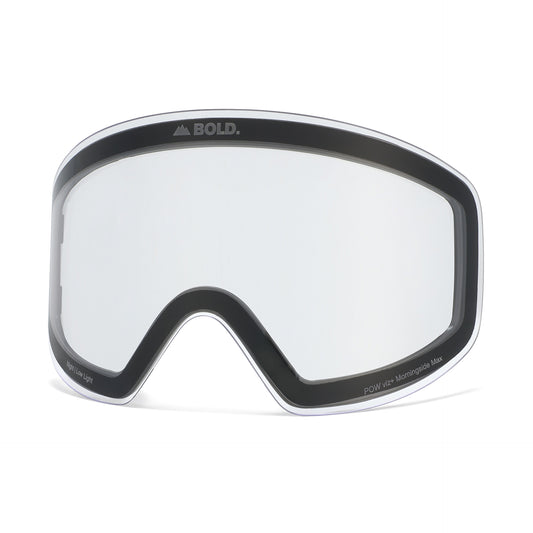
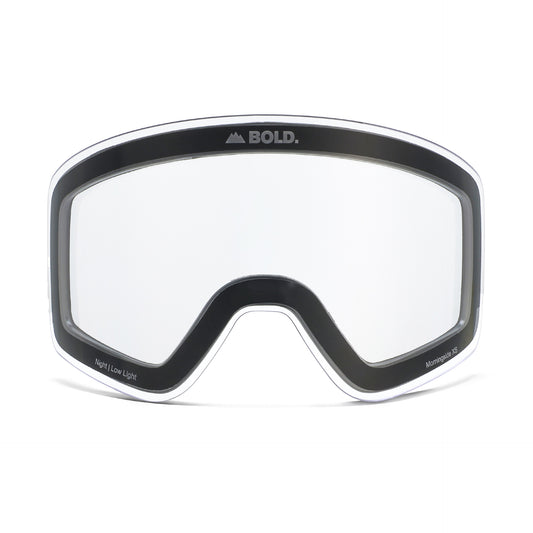
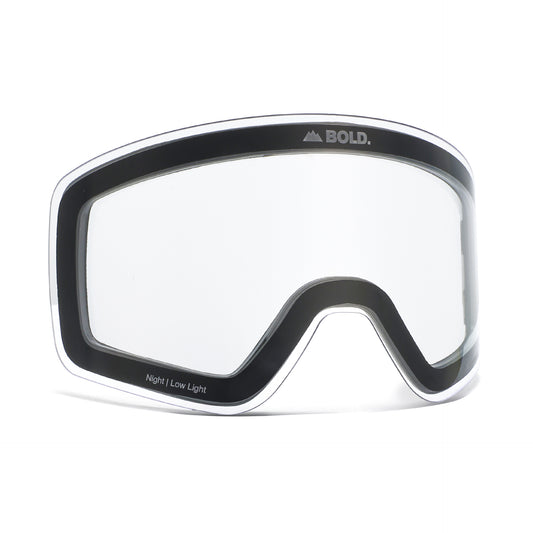
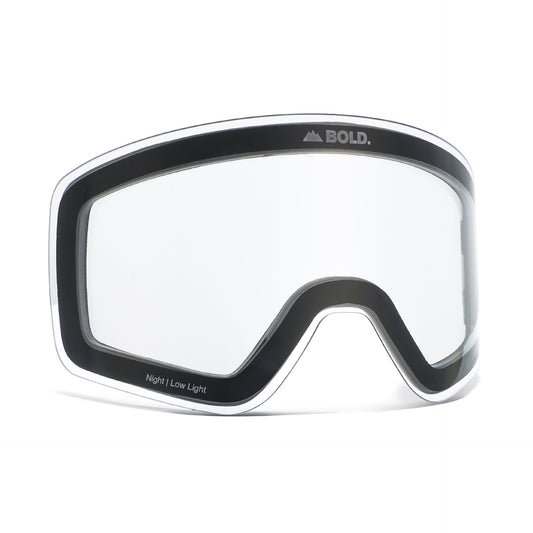
Not all low-light situations call for the same lens. Here is a quick guide to choosing the right option for the conditions you are skiing in.
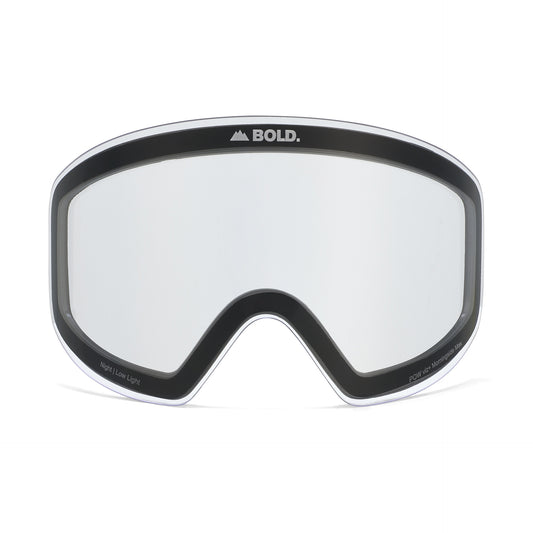
Night skiing under lights: Clear lens at 85% VLT. Artificial light levels are low and you want every photon reaching your eyes. This is the only scenario where a clear lens is clearly the optimal choice.
Heavy daytime snowfall, white-out, or flat light: Our stormy day lenses with POW Viz Plus technology, Citrus Blaze, Cherry Frost, or Arctic Glow, are the better choice here. They sit at 40% to 44% VLT and add contrast enhancement that helps you read the terrain in flat, featureless light. A clear lens will technically work, but the contrast boost from a stormy day lens makes the terrain much easier to navigate.
Dawn patrol or early morning before sunrise: Clear lens is ideal. Light levels are extremely low and a clear lens maximizes what you can see.
Indoor ski slope or training tunnel: Clear lens. Same logic as night skiing, artificial light and maximum transmission needed.
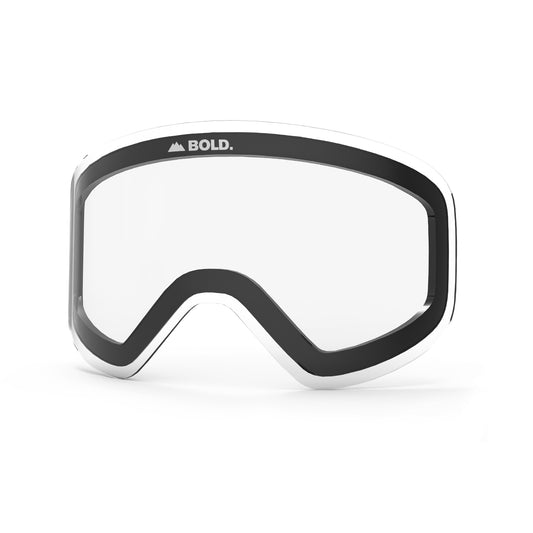
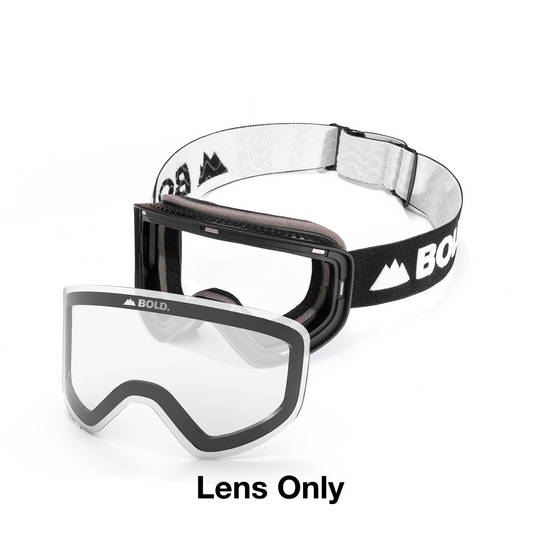
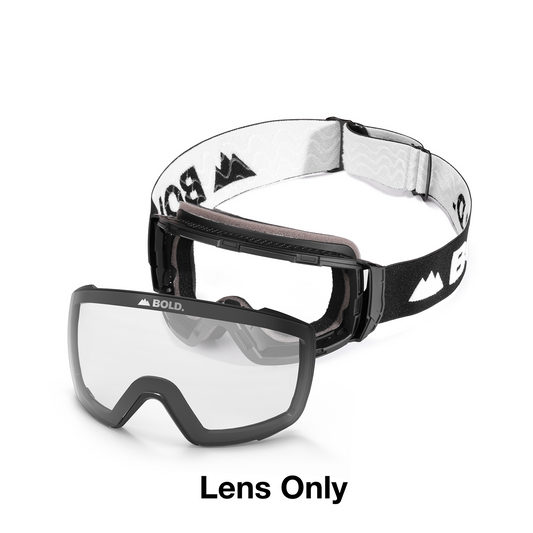
BOLD's magnetic lens system makes it easy to carry a clear lens as a backup for any night session. It fits in a small goggle case or jacket pocket and clicks in without removing your gloves. If your day session runs late or you decide to stay for the evening session, you are ready.
When to Use Clear Ski Goggle Lenses
Clear lenses are purpose-built for low-light situations. Reach for them when:
- Night skiing — artificial lighting is your only source. A dark lens cuts that further; a clear lens uses every photon available.
- Indoor terrain parks and domes — controlled artificial light, same logic as night skiing
- Heavy storms and blizzards — precipitation flattens contrast; a clear lens preserves whatever ambient light gets through
- Deep overcast and flat light days — when the sky is a uniform grey and depth perception disappears, maximum VLT is your best tool
- Pre-dawn and post-dusk laps — that window before the mountain fully lights up or after it goes dark
See the full breakdown of when to use which lens tint in our ski goggle lens guide.
High VLT: Why It Matters
VLT is the percentage of available light that passes through a lens and reaches your eye. A lens with 10% VLT is dark — great for bluebird sun days. A clear lens, like our 85% VLT clear lenses, lets nearly all light through, which is what you want when light is scarce.
In low-light conditions, every percentage point matters:
- A tinted storm lens at 50–65% VLT still blocks nearly half the available light
- A BOLD clear lens at 85% VLT passes nearly all the light the environment offers
- Better light transmission means better depth perception and better edge reading on the snow
For night skiing in particular, there is no substitute. A clear lens is the correct tool, and using anything darker puts you at a real visibility disadvantage.
Fitting Clear Lenses to Your BOLD Goggles
BOLD uses a frame-specific magnetic lens system, so compatibility depends on your goggle model. Here's how to find the right clear lens:
- Morningside goggles (standard, Max, XS, OTG): Shop Morningside lenses — clear lenses are available for all Morningside frame variants
- Rambler goggles: Shop Rambler lenses — the Rambler has its own magnetic lens ecosystem
- All replacement lenses: Browse all BOLD replacement lenses if you're unsure which frame you have
Each lens clicks in magnetically — no tools, no fumbling, and the swap takes about three seconds even with gloves on. If you need something between clear and dark for stormy conditions, check out our stormy day ski goggle lenses for lenses optimized for low light without going fully clear.
Frequently Asked Questions
What VLT is best for night skiing?
A clear lens. BOLD clear lenses are 85% VLT. At night, your only light source is the resort lighting. Any tint reduces that further and reduces your visibility. Clear is always the correct choice for night skiing.
Can I use clear lenses in daytime?
On overcast storm days, heavy snow, or deep flat light days, yes — clear lenses work well and can improve depth perception when the sky is a uniform grey. In bright sun or even partial sun, a clear lens will cause glare and eye strain. For variable conditions, consider our photochromic auto-tint ski goggles instead.
Are BOLD clear lenses compatible with all BOLD goggles?
No. Lenses are model-family specific. Standard Morningside lenses fit the Morningside, Morningside OTG, Morningside Low Bridge and Morningside AutoTint. The Morningside XS, Morningside Max, Rambler and Morningside Youth each take their own lenses, so choose the clear lens made for your goggle's family. If you're not sure, check the product page for your goggle — it lists compatible lenses directly.
Not sure which goggle you have? See Which BOLD Ski Goggle Do I Have?.
Stop squinting at the night mountain. Shop BOLD clear ski goggle lenses above and see everything the slope has to offer after dark.